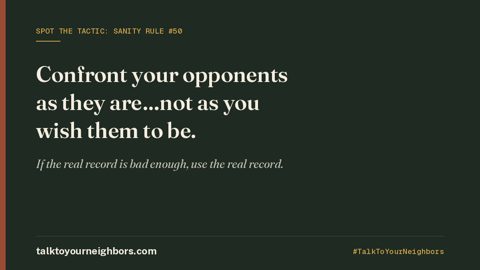
The rule: Disagreeing with a choice doesn't mean you abandon the person, and demanding 100% lockstep is the mark of someone who wants to dominate (Rule #26).
Why this rule fits: one Democrat broke with her party on ONE vote. Both headlines below turn that single choice into a verdict on a whole person or a whole party.
Feel that jolt of betrayal? Or that smug "told you so"? Set it down. Just for a minute.
The story
Rep. Haley Stevens, who lost Michigan's Democratic Senate primary to Abdul El-Sayed, endorsed Republican Mike Rogers two days before Election Day. She said El-Sayed had told her she was no longer welcome in his campaign. Party leaders condemned her, and the state party chair said she is no longer a party member. (AP via WPXI, Nov. 1, 2026)
Left-leaning headline
HuffPost: "Establishment Democrats And Progressives Can Agree On 1 Thing: Haley Stevens Is A Traitor" (Nov. 1, 2026)
- Emotion: Anger at a betrayal.
- Trigger words: "Traitor." Its quotes include "despicable betrayal" (Schumer) and "dangerously betray" (Pelosi).
Through a calm, logical lens
-
Known: Stevens endorsed Rogers. Her chief of staff resigned ("We are shocked and heartbroken"). She told AP, "I'm not turning my back on Democrats. It is this one vote."
-
Claimed: She's a "traitor," which is a word for someone who betrays a country, not a candidate.
-
Context: Stevens is a strong supporter of Israel and El-Sayed is a fierce critic. El-Sayed has been criticized over past remarks about a synagogue attack. AIPAC's affiliated super PAC backed Stevens in a primary that drew tens of millions of dollars in outside spending (AP).
-
Missing: Any sign she switched parties or changed a policy position.
-
What would have to be true: for "traitor" to fit, one endorsement would have to erase a whole career. Would you accept that standard for yourself?
Calmer headline: "Democrats condemn Stevens's endorsement of Republican Rogers"
Right-leaning headline
RedState: "MI Dem Party Chair's Disgusting Move Against Haley Stevens - So Much for That 'Big Tent'" (Nov. 1, 2026). The URL reads "goes full Stalin… no dissent allowed."
- Emotion: Disgust, plus fear of a party that punishes dissent.
- Trigger words: "Disgusting." In the body: "downright Stalinist" and "how off the rails Democrats have become."
Through a calm, logical lens
-
Known: State party chair Hertel said Stevens "is not a current member of the Michigan Democratic Party, nor will she be in the future" (AP).
-
Claimed: that this shows Democrats as a whole tolerate NO dissent.
-
Context: Parties on both sides do this. In 2021 the Wyoming GOP central committee voted 31-29 to stop recognizing Liz Cheney as a Republican after she voted to impeach Trump (NBC News).
-
Missing: that comparison. The piece calls this move "Stalinist" without mentioning that a Republican party did the same thing.
-
What would have to be true: Stalin jailed and killed his dissenters. A state party took away one member's card. If "Stalinist" fits Michigan, it fit Wyoming too.
Calmer headline: "Michigan Democrats cut ties with Stevens after Rogers endorsement"
Through the rule
Here's the question. How EXACTLY does one endorsement turn a Democratic congresswoman into a traitor... or turn a whole party into Stalin?
It doesn't. Both headlines need you to believe that disagreeing on ONE thing defines someone completely. That's Rule #26 in reverse. A party that demands lockstep shrinks. A critic who says "Stalinist" about something their own side has done loses the argument.
If your neighbor believes the HuffPost headline: "You can think her endorsement was a mistake. I might, too. But 'traitor'? She said it was one vote. If someone on your side broke ranks once, would you want them kicked out for good?"
If your neighbor believes the RedState headline: "Fair point that kicking her out looks petty. But the Wyoming GOP did the same thing to Liz Cheney. Was that Stalinist too, or is it only Stalinist when it's them?"
What both sides agree on
- Stevens endorsed Rogers, and the Michigan party cut ties with her.
- Voters, not party chairs, decide Tuesday. More than 1.8 million Michiganders had already voted early (AP).
- Nobody likes a party that takes them for granted.
Getting to the root
The underlying issue: Primaries that treat losing as betrayal, and party loyalty tests that can push people out the door.
-
Open or top-two primaries (NCSL). Tradeoff: supporters say moderates have a better shot. Opponents say it can reduce voter choice and hurt minor parties.
-
Tighter disclosure of outside money in primaries. Tens of millions came into this one (AP). Tradeoff: disclosure rules raise free-speech questions, and money tends to find another channel.
-
Written party standards for discipline, so removal isn't decided in the heat of the moment. Tradeoff: parties are private groups, and rules can be used as weapons too.
Curious questions for your neighbor:
- What's the line between disagreeing with your party and leaving it?
- Did the Cheney vote and the Stevens vote feel different to you? Why?
- Would you want a party that has room for people like her?
- What would make you cross party lines for one race?
One vote isn't a membership card. Respect the person. Argue the choice. We're FOR parties big enough to hold disagreement… and neighbors who can, too.
TalkToYourNeighbors
Principles at play: #26 (support without lockstep), #42 (same standard: Cheney and Stevens), #7 (critique the choice, not the person).