"With malice toward none, with charity for all, with firmness in the right as God gives us to see the right, let us strive on to finish the work we are in, to bind up the nation's wounds, to care for him who shall have borne the battle and for his widow and his orphan, to do all which may achieve and cherish a just and lasting peace among ourselves and with all nations."
Abraham Lincoln, Second Inaugural Address, March 4, 1865 (Avalon Project, Yale Law School)
Yesterday America voted. This morning, some of us are relieved and some of us are worried. But whether your candidate won or lost, and how you feel about it, isn't the point. The question is what all of us do next. We're still neighbors.
Think about when Lincoln said those words. He'd been re-elected, the Union army was winning, and the end of the war was close. If any leader ever had the right to spike the ball, it was him.
He didn't. In the same speech he said both sides "read the same Bible and pray to the same God," and then he added, "let us judge not, that we be not judged." He was firm about what was right, and he never backed off ending slavery. But he refused to treat the people on the other side as enemies forever.
Where the hard races landed
Democrats won control of both the Senate and the House, according to race calls by the Associated Press (AP; NPR). Some individual races, including Maine's 2nd District and Alaska's Senate seat, are still being counted.
- The Senate. Republicans went in with a 53-47 majority, and Democrats needed a net gain of four seats to take control (Reuters, Nov. 2). Going into Election Day, the races in Alaska, Iowa, Kansas, Maine, Michigan, Ohio and Texas were all rated toss-ups (Newsweek). Democrats flipped at least seven seats, including Kansas, Iowa, Texas, Ohio and Maine, and held Michigan, which gives them control of the Senate (AP; NPR). Alaska is still being counted, and it may go to ranked-choice tabulation (AP).
- The House. Every seat was on the ballot, and the competitive map grew in the final week, according to the nonpartisan Cook Political Report (Washington Post, Nov. 2). Democrats reached the 218 seats needed for a majority, flipping more than two dozen districts (AP; AP on the call). Some seats are still being counted.
- A few races the whole country watched:
- Texas Senate: James Talarico (D) vs. Ken Paxton (R). No Democrat has won statewide in Texas since 1994 (NPR). Talarico won, about 55% to 43% with more than 95% of votes in (AP; NPR).
- Michigan Senate: Abdul El-Sayed (D) vs. Mike Rogers (R). This was Republicans' best chance to flip a Democratic seat (The Hill). El-Sayed won, about 52% to 46% with about 95% of votes in (AP; AP live updates).
-
Ohio Senate special election: Sherrod Brown (D) vs. Sen. Jon Husted (R) (Reuters). Brown won (AP; Washington Post).
-
Here at home in Maine, Sen. Susan Collins (R) faced Troy Jackson (D) in a toss-up that could tip the Senate. The final New York Times/Press Herald/Siena poll had Jackson up 51% to 45% (Press Herald). Maine also chose a new governor and voted on the open 2nd District seat. Jackson won the Senate seat with about 54% of first-choice votes, a majority, so no ranked-choice round is needed (AP; The Guardian). Hannah Pingree (D) was elected governor over Bobby Charles (R) and Rick Bennett (I) (AP via NPR; WABI). The 2nd District race between Paul LePage (R) and Matt Dunlap (D) is still being counted. It was separated by a few hundred votes with about 84% in, and it could go to ranked-choice tabulation (AP via NPR; WABI).
Notice that I didn't say "congratulations" or "I'm sorry." Whether my candidate won or lost, and how I feel about it, is irrelevant. What matters is what happens now.
What we agree on, coast to coast
Here's what the ads didn't tell you. In the races that divided us most, voters on both sides named the SAME top worry.
- The economy is number one for both sides. In a Pew survey, 82% of voters backing Republicans and 88% of voters backing Democrats said the economy was very important to their vote. It was the top issue for both groups (Pew Research Center, Oct. 8).
- Voters want the next Congress to lower costs, whoever wins. About 8 in 10 registered voters, including large majorities of Republicans and Democrats, said lowering the cost of living should be a priority (AP-NORC poll via AP).
- Both sides care about the system itself. Clear majorities in both parties, 69% of Republican voters and 85% of Democratic voters, said the future of democracy was very important to their vote (Pew). We may define it differently, but we both want it to work.
That's "the work we are in." Grocery bills, gas prices and a government that works don't belong to one party.
Four pieces of one sentence
"With malice toward none." Malice is easy right now. It shows up in a group chat, a yard sign joke or a comment you'd never say to someone's face. Lincoln set the bar at none, not "less."
"With charity for all." Charity here doesn't mean giving money. It means assuming the best you reasonably can about someone. Your neighbor who voted the other way probably wasn't voting against you. They were voting for something they care about, like their job, their kids, their bills or their town.
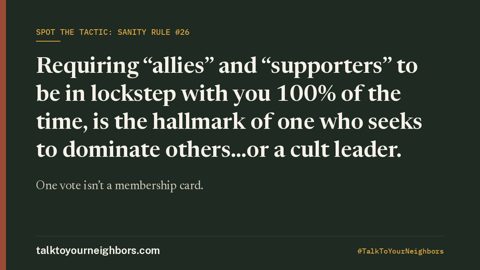
"With firmness in the right as God gives us to see the right." This is the part people skip. Lincoln didn't say to give up your convictions. He said to hold them firmly, with a little humility built in: as God gives us to see the right. That means as best we can see it, not perfectly. You can be firm without trying to dominate anyone (Rule #26), and if the pendulum swung your way, you can resist the urge to overplay your hand (Rule #29).
"To bind up the nation's wounds." Wounds don't close on their own when they keep getting reopened. Binding them up is work, and it's done one person at a time.
The morning after: the starting line
Here's what I'd ask all of us to think about. Whichever candidate won just hit the starting line. Their work is just beginning. They now represent the ENTIRE constituency, including every person who voted against them.
- If your candidate lost, lose gracefully. Unless there's a real challenge or a real irregularity, which is what courts and election officials are there to handle, accept the result and say so.
- Then get to work on the common ground. Find the issues where you can help the winner succeed. Their success on grocery bills, health care costs or the road that needs fixing is your community's success.
- Keep your convictions. Helping the winner where you agree doesn't mean giving up your ideas. Keep advocating for your policies and your ideals, firmly and in the open. That's "firmness in the right," not surrender.
- If your candidate won, remember they work for everyone now, including your neighbors who voted the other way. Skip the victory lap.
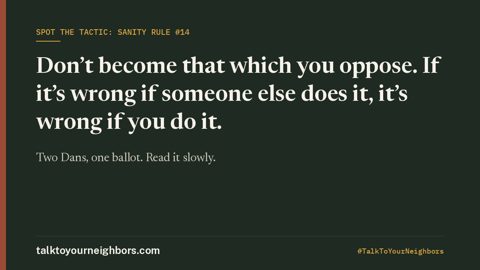
- Use the same standard for both sides. If you'd want grace when you lose, offer it when you win (Rule #42). If a close race takes days to count, give the count the patience you'd want if your candidate were the one waiting.
- Start from the common ground. Bring up grocery prices or the cost of health care with someone who voted differently. You'll probably agree on more than you expect.
- Care for those who've carried the weight. Lincoln named the soldier, the widow and the orphan. Today that might be a veteran down the road, a family that's struggling, or the poll workers who worked a very long day, whether in a big city or a small Maine town.
The work we are in
Lincoln never got to see the peace he described. He was killed about six weeks later. But he left all of us the instructions, and they still work.
Election Day isn't the finish line. For the winner, it's the starting line, and the job is to serve everyone. For the side that lost, the job is to concede with grace, find the common ground and keep making its case. And our job, as neighbors, is to hold both of them to that.
So here's my question for you: what's one issue you and someone who voted differently both want fixed? Tell us in the comments.
#TalkToYourNeighbors
Principles at play: #26 (firmness without lockstep), #29 (don't overplay your hand), #42 (same standard both ways).