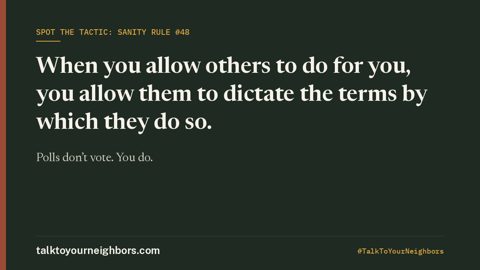
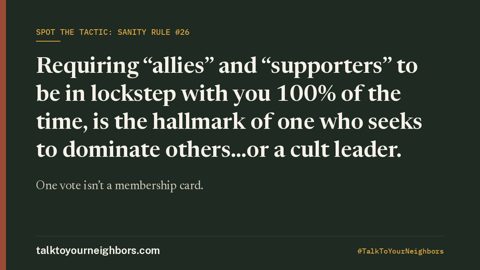
The rule: Don't become that which you oppose (Rule #14).
Why this rule fits: in Alaska, a "decoy" candidate is being used to say the race is rigged, and a lawsuit to hold up certification is being used to say it's being stolen. Each side's tactic is the other side's proof.
It's Election Day. If you're being told the Alaska Senate result "won't count" no matter what… slow down. Here's what's actually on the ballot.
The story
Alaska's Senate ballot has four names. Among them: the Republican incumbent, Sen. Dan S. Sullivan, Democrat Mary Peltola, and a retired teacher listed as Daniel J. Sullivan Jr. (Alaska Division of Elections candidate statements: Dan S. Sullivan, Daniel J. Sullivan Jr.). The New York Times reported that people working with Peltola's team tried to recruit spoiler candidates; Peltola denies knowing about it. The Justice Department sued to delay certification if the incumbent loses. A federal judge dismissed the suit, saying the government gave "no workable plan" to investigate ballots "in a manner that would preserve voter secrecy." DOJ says it will appeal (BBC, Nov. 2, 2026). Gov. Mike Dunleavy has ordered a state investigation and hasn't committed to certifying (Axios, Oct. 29).
Right-leaning headline
New York Post (Ryan King): "Alaska Sen. Sullivan warns alleged 'Decoy Dan' scheme is working: 'I'm going to lose a lot of votes to that trickery'" (Nov. 1, 2026)
- Emotion: Anger and despair. "It's rigged, and it's working."
- Trigger words: "scheme," "trickery," "Decoy Dan." In the body: "bombshell revelations," and a Che Guevara refrigerator magnet.
Through a calm, logical lens
-
Known: The NYT reporting ties Peltola-connected operatives to recruiting a same-name candidate. Her former campaign manager says Peltola was "definitely aware."
-
Claimed: that the scheme "is working."
-
Context: Nobody knows that yet. There's no vote count. And the Post itself reports Sullivan said, "I'm going to accept the election results."
-
Missing: That fridge magnet. It's color, not evidence.
-
What would have to be true: For "working," voters would have to be fooled at scale. The official names differ: Dan S. Sullivan vs. Daniel J. Sullivan Jr. (Alaska Division of Elections), so a careful voter can tell them apart.
Calmer headline: "Sullivan says same-name rival may cost him votes, vows to accept result"
Left-leaning headline
MeidasPlus (Brett Meiselas): "Here We Go Again: Trump DOJ Moves to Block Certification of Alaska Senate Election if Republican Loses" (Oct. 23, 2026)
- Emotion: Fear and weary despair. "They'll overturn it anyway."
- Trigger words: "Here We Go Again," "Trump regime." In the subhead: "laying the groundwork to challenge a Democratic victory."
Through a calm, logical lens
-
Known: DOJ did file that suit, and Trump said he directed it (BBC).
-
Claimed: that it's a replay of 2020, a setup to overturn the result.
-
Context: A judge has since thrown it out. Election-law experts say Alaska's Division of Elections certifies, not the governor (Axios).
-
Missing: The real scandal that started it, the same-name recruiting. It goes unmentioned.
-
What would have to be true: For "here we go again," the suit would have to succeed. It's 0-for-1, and the appeal clock is short.
Calmer headline: "Judge tosses DOJ bid to delay Alaska certification; appeal planned"
Through the rule
Here's the thing. If someone recruited a decoy to confuse voters, that's a dirty trick. And the answer to a dirty trick is NOT to hold up everyone's ballot and pull them apart, secrecy be damned.
Each side is fighting "rigging" with a tactic that looks a lot like rigging. That's how you become what you oppose (Rule #14).
The calmest voice in this whole mess? Sen. Sullivan himself: "I'm going to accept the election results." That's the adult in the room (Rule #3).
If your neighbor believes the Post headline: "If they recruited a decoy, that's wrong, and I hope it's investigated. But even Sullivan says he'll accept the result. So why should we tell Alaskans it's already rigged?"
If your neighbor believes the MeidasPlus headline: "The suit got thrown out. But what about the decoy recruiting? If it were our side's guy getting split, wouldn't we be mad too?"
What both sides agree on
- Voters shouldn't be tricked by names on a ballot.
- Secret ballots stay secret.
- The winner should be whoever Alaskans actually chose.
Getting to the root
The underlying issue: Each side treats the other side's dirty trick as permission for its own.
What We The People can do at the ballot box, today:
-
Read the whole ballot slowly. Alaska uses a top-four ballot with ranked-choice voting (NY Post). The middle initial matters: Dan S. Sullivan is the incumbent; Daniel J. Sullivan Jr. is the retired teacher. So does the rest. Tradeoff: thirty more seconds in the booth.
-
Vote for the offices that certify. Secretaries of state and election officials sit on ballots across 26 states today (Ballotpedia). Pick people who'll certify the count, whoever wins it. Tradeoff: it's not exciting.
-
Punish tricks at the ballot box, from either side. If a campaign recruited a decoy or tried to stall a count, that's a reason to vote against it. Courts take months. Voters decide in one day. Tradeoff: you might have to vote against your own team.
Curious questions for your neighbor:
- Which bothers you more, a decoy candidate or a stalled certification? Why?
- Would your answer change if the parties were flipped?
- What would a fair fix for same-name candidates look like?
Both sides want a clean race. So run one. And vote like it's yours to decide… because it is.
TalkToYourNeighbors
Principles at play: #14 (don't become what you oppose), #3 (be the adult in the room), #42 (same standard: decoys AND stalled counts).