The rule: When you allow others to do for you, you allow them to dictate the terms (Rule #48).
Why this rule fits: one side says the polls prove it's over, the other says the polls are a rigged plot to make you stay home. Either way, someone else is deciding for you whether your vote counts.
It's Election Day. If you've been told it's already decided… notice who's telling you, and what they want you to do next.
The story
Polls show Democrats ahead on the national generic ballot, with Trump's approval in the mid-to-low 30s. But CNN's polling analyst writes that there's "far less certainty" about how that plays out race by race. Democrats are answering polls more readily than Republicans ("differential nonresponse"), and 6% to 8% of voters in CNN's final state polls still picked "neither." Presidential polls underestimated Republicans in 2016, 2020 and 2024, but "there hasn't been a similar pattern in Trump-era midterm elections" (CNN, Nov. 2, 2026).
Left-leaning headline
Adam Kinzinger (Substack): "BREAKING: Polls Show Trump Losing Everywhere, GOP Blames Trump for Collapse, DOJ Caught With Fake Voter List, and more..." (Nov. 2, 2026)
- Emotion: Triumph for one side, despair for the other. "Don't bother, it's over."
- Trigger words: "Losing Everywhere," "Collapse." In the body: "a future without MAGA" and "the nail in the coffin for this movement."
Through a calm, logical lens
-
Known: The NYT/Siena polls he cites show Democrats leading several Senate races. Nate Silver's model gives Democrats an 80% Senate chance.
-
Claimed: "Losing Everywhere."
-
Context: 80% means one in five times, it doesn't happen. To his credit, Kinzinger says it himself: "these are polls and models, not results… a lot of these races are still coin flips."
-
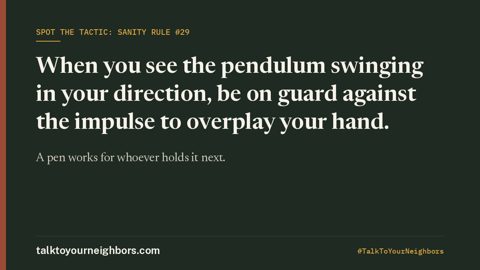
Missing: That line is buried. "Everywhere" and "Collapse" are the headline. And "nail in the coffin" is what overplaying your hand sounds like. When the pendulum swings your way, be on guard against that impulse (Rule #29). Victory laps before the votes are counted make the other side angrier, not smaller.
-
What would have to be true: For "everywhere," races inside the margin of error would have to be settled. They're not. That's what today is for.
Calmer headline: "Final polls favor Democrats, but key Senate races remain within the margin"
Right-leaning headline
Townhall (Jeff Crouere, column): "The Unholy Alliance Between the Media and the Polls" (Nov. 2, 2026)
- Emotion: Anger and distrust. "They're manipulating you."
- Trigger words: "Unholy Alliance." In the body: "corrupt media," and polls whose "purpose was not to inform, but to influence."
Through a calm, logical lens
-
Known: Fake pollsters were exposed this cycle. Wedgewood Polls admitted to "fabricated numbers," and that hurt a Democrat (Mallory McMorrow) as well as Republicans.
-
Claimed: that polls are a coordinated plot to suppress GOP turnout.
-
Context: A real problem, differential nonresponse, is confirmed by pollsters themselves (CNN). That's a flaw, not a conspiracy.
-
Missing: That the same flaw has gone the other way in past midterms.
-
What would have to be true: For "alliance," pollsters would have to want to be wrong. Their whole business is being right.
Calmer headline: "Polls face real response problems, and both parties are skeptical of them"
Through the rule
Look at what both headlines do. One tells Republicans it's over. The other tells Republicans the polls are lying to make them think it's over. Either way, the conversation is about the poll… not about you.
That's the trap. When you let a poll, a pundit or a column decide whether your vote matters, you've handed them the terms (Rule #48). Polls don't vote. You do.
And the "it's decided" mood is how upsets happen. Small margins are real. Iowa's 2nd District was decided by six votes in 2020 (CBS News).
If your neighbor believes the Kinzinger headline: "Maybe. But he said himself a lot of these are coin flips. Would you skip voting on a coin flip?"
If your neighbor believes the Townhall headline: "Some polls really were fake, and one of them hurt a Democrat. But if you think polls are wrong, the only way to prove it is to vote. Hmmm… sounds like a plan either way."
What both sides agree on
- Fake polls are bad for everybody, and this cycle proved it.
- Nobody should stay home because a forecast told them to.
- Results beat predictions. Tonight, we get results.
Getting to the root
The underlying issue: Horse-race coverage turns voters into spectators, and spectators don't show up.
What We The People can do at the ballot box, today:
-
Vote like it's close, because some of it is. One vote in about 15,000 in state legislative elections went to a candidate who tied or won by a single vote (Mulligan and Hunter, via The Rational Moderate). Tradeoff: you'll never know if yours was the one.
-
Look past the top line. 44,443 races are on ballots today (Ballotpedia). Most were never polled at all. Tradeoff: you'll have to read your sample ballot.
Curious questions for your neighbor:
- Has a poll ever changed whether you voted?
- What race on your ballot do you know the least about?
- If the polls were perfect, would you still vote? Why?
What you're FOR doesn't depend on who's ahead (Rule #45). Go vote it.
TalkToYourNeighbors
Principles at play: #48 (don't let others decide for you), #29 (don't overplay your hand when the pendulum swings your way), #52 (don't believe everything you see on the internet, fake polls included), #45 (what you're FOR).